Why Smash the War Machine (“Knus Krigsmaskinen!”) must also mean Smash Colonialism
Reflections on the the Actively Defended Zone (AFS) Hurummarka and Sámi resistance
This text reflects on the anti-colonial solidarity efforts of Knus Krigsmaskinen!, an anti-militarist forest occupation in Norway. It explores the opposition which Knus Krigsmaskinen! received from liberal Sámi activists and dives into the nourishing conversations and relationships that developed from these frictions.
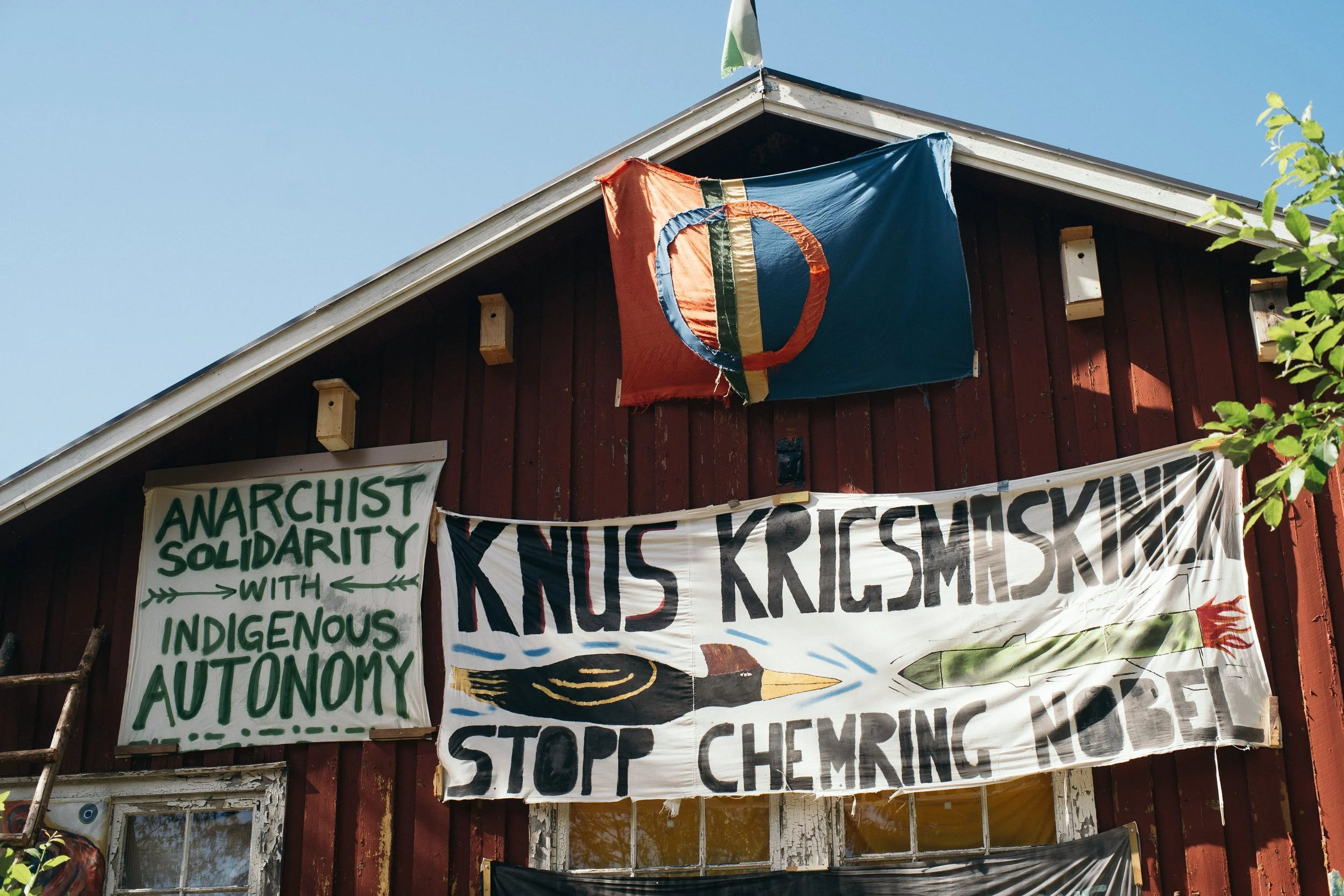
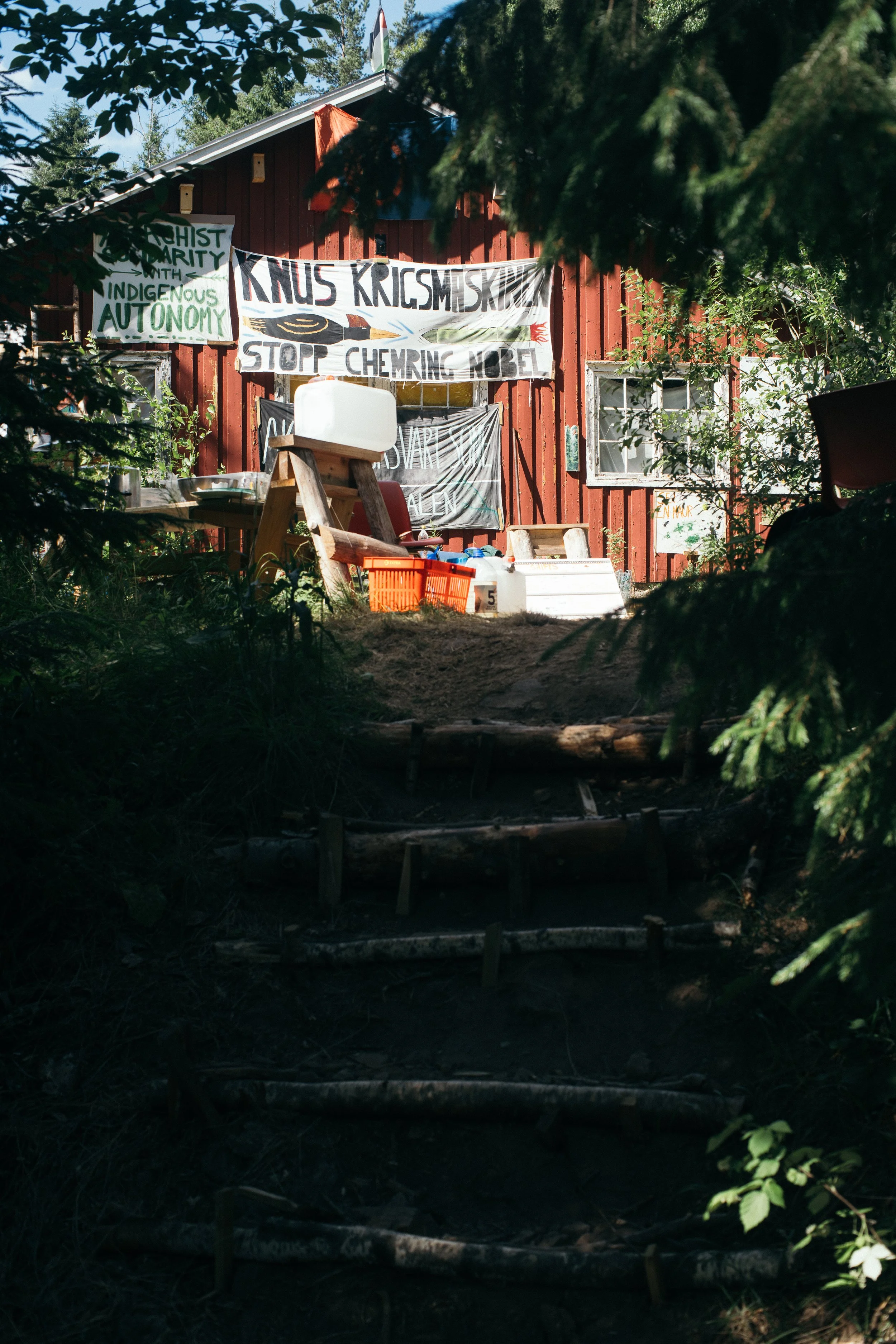
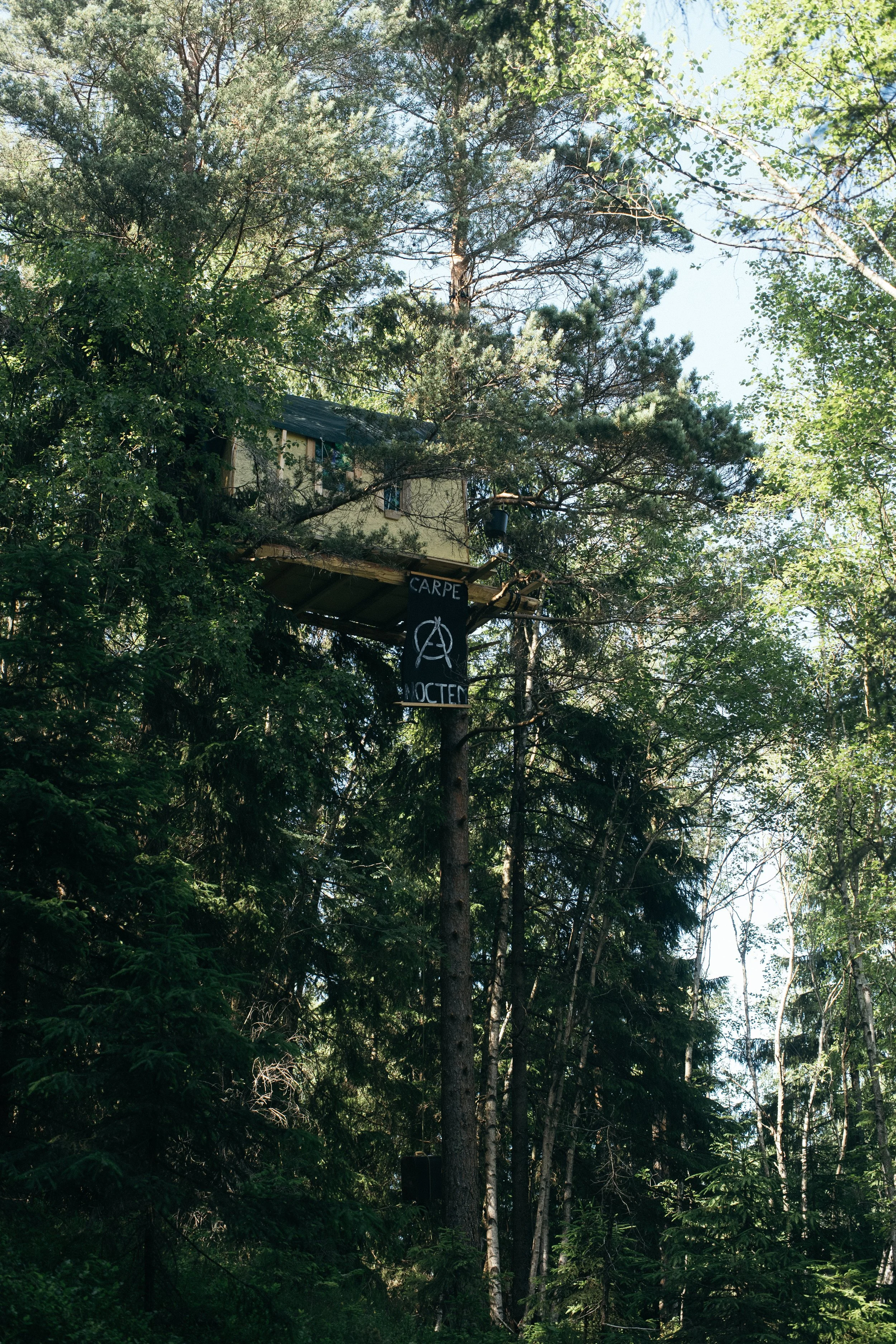
Knus Krigsmaskinen! ("Smash the war machine!") is the name of the new forest occupation in Hurummarka, southern Norway. AFS stands for Aktivt Forsvart Sone (“actively defended zone”) and refers to the Avgrunnsdalen valley, which the forest inhabitants defend against the construction of a new military explosives factory. For some background info read “A letter from the Abyss: Forest occupation in southern Norway celebrates two months of struggle against the state, the military, and their world”
Ever since we moved into the abandoned military barrack in Avgrunnsdalen on April 2nd to defend Hurummarka against Chemring Nobel's war factory, Knus Krigsmaskinen! has expressed solidarity with Sámi struggles for land and life. For us, the fight against the war machine is connected to the struggles for liberation in Sápmi as it is to those in Palestine. We have expressed this solidarity first through statements on our website and through attaching the Sámi flag to the front of the house. Later, we did so through solidarity posts on social media and a speech at the anti-racist demo in Oslo. From the start, all these acts were accompanied by ongoing conversations with, and appreciation from, our Sámi friends and comrades.
And ever since we expressed this connection (and solidarity), we had to argue for it. First, within our own circles, where people think it is not strategic to speak about Norwegian colonialism, suggesting it would not get us enough supporters to protect the forest with us. Then with some locals who, confirming the strategic fears of some of us, feel attacked in their Norwegian identity and fear that their fight to protect the forest and fjord is misrepresented by relating it to Sápmi. While these reactions were to be expected, we have increasingly been facing opposition from individual Sámi activists in the last couple of weeks.

What follows are some more curated reflections on why, despite all this opposition, we insist on putting the fight against Chemring Nobel and the military industry, with all its ecocidal, genocidal, and sham democratic facets, into direct conversation with the anti-colonial struggle for Sápmi. These reflections emerge out of discussions between dáza (non-Sámi person) and Sámi comrades before and during the midsummer camp in Avgrunnsdalen, which culminated in an open workshop on the final day of the camp titled "What's happening in Sápmi? Colonialism, the "green" transition, and anarchist solidarity" on June 28th 2026. The workshop was initiated by some people from Knus Krigsmaskinen! and some of our Sámi friends, to whom our deepest gratitude belongs for making their journey all the way to the forest and for supporting us in this educational and exploratory endeavor.
"This is not a Sámi struggle": Sámi activists rejecting solidarity from Knus Krigsmaskinen!
Over the past weeks we received several messages via social media, where individual Sámi activists expressed their concerns with our solidarity efforts. This section briefly reviews the three main concerns, but without directly responding to them individually. As these concerns share underlying assumptions, we instead respond to them collectedly in the final section.
First, and centrally, our critics consider the attachment of the Sámi flag to the house front as an appropriation, an act pursued without the consent from a majority of Sámi. We were accused of "posing" with the flag to increase attention for our own struggle against Chemring. When we responded, that we hung the flag in conversation with Sámi comrades, we were met with an accounting game, informing us that our Sámi friends are far fewer than those who oppose the flag on the AFS house, and that our friends can not represent the entire Sámi community.
Second, and connected to the first concern, we were accused of "knowingly increasing anti-Sámi hatred" with drawing attention to Sámi struggles, as this would increase racist acts against Sámi.
Third, and arguably at the base of previous arguments, we were told that the fight against Chemring Nobel is "not a Sámi struggle", as it is neither on Sámi ancestral territories nor led by Sámi people.
The struggle against Chemring Nobel is necessarily a struggle against colonialism
Instead of reacting to these critiques by withdrawing our solidarity or making it less visible, we deepened the conversations with our Sámi comrades and among ourselves in Avgrunnsdalen. Those conversations, including the above-mentioned workshop on our midsummer camp, circled around four central questions:
• What could anarchist solidarity with Sámi struggles for autonomy look like?
• How does an anarchist position interrelate with Indigenous struggles and realities?
• How can we stay in conversation and express solidarity beyond the daily tokenism or symbolism? Said differently, how can we build mutual relationships and become accomplices?
• How can we deal with the repercussions of increased visibility which Sámi might encounter due to our solidarity efforts?
What follows are some unfinished conclusions from our conversations among each other and with Sámi comrades before, during, and after the midsummer camp.
Anarchist solidarity with Sámi struggles for autonomy to us means that we do not, and never did, seek the consent or support of a majority of Sámi to our actions and claims. We express solidarity specifically with Sámi resistance that has a clear anti-colonial politics, rather than protest that is assimilated into the Norwegian state apparatus and into the pacified culture of Norway's majority population. Any politics that are entirely controllable - and often funded - by the colonial state, whether the Sámi parliament or protest culture promoted by organizations such as Natur og Ungdom, express an assimilationist politics via the colonial technologies of (‘indirect’) governance or NGO complex. We do not judge individuals for accepting certain political compromises as a survival strategy. But we oppose the organized promotion of assimilated resistance and, independently of the judgment of such, we express our solidarity with autonomous resistance. Akin to the political discussions among the Sámi in the 1970s/1980s, debates between reformist and anti-state positions reemerge in Norway. These discussion resurface across Indigenous struggle around the globe, which have been heavily debated in the territories occupied by Canada. As such, the political position we support among our Sámi comrades, is one that has always existed (and been actively suppressed) among Sámi communities, and deserves attention and support in a time of increasing pressures on Sámi territories and traditional life ways.
Our anarchist position interrelates with and is inspired by Indigenous struggles and realities in our shared rejection of socially and ecologically damaging industrial infrastructures, such as mines, chemical plants, energy infrastructures and military projects). Extractive projects, moreover, impede Indigenous and non-Indigenous animist and/or land-based worldviews and ways of life, living with and complementing our environments instead of extracting from and destroying them. As we seek to embrace and strengthen such worldviews and land practices, our position interrelates and has common ground with Indigenous struggles also in rejecting any (colonial) state and destructive infrastructures, as well as the societies it creates.
To stay in conversation about this solidarity, and to deepen our relationships with Sámi comrades, we want to focus on educating each other here in Avgrunnsdalen and also dáza elsewhere. Besides organizing talks and workshops in the forest, we intend to include the issue of Norway's (as well as other Nordic states') ongoing settler colonialism in Sápmi wherever we have public talks about Knus Krigsmaskinen!, and to continue making an anti-colonial position an essential part of our struggle. We also aim to keep inviting Sámi comrades for conversations and, importantly follow invitations to the north to learn from each other. Through these efforts, we hope to nurture relationships and networks that can outlive the struggle against Chemring Nobel and blossom also in future and distant struggles.
We acknowledge the risks and potential repercussions of our solidarity efforts. However, it is a fundamental function of the settler colony to meet resistance with increased violence, whether that is through authorities (fines, arrest, beatings, surveillance) or through the acts of individual settlers. We understand, that avoiding resistance is for many, out of fear for repercussions, a survival strategy, but it also plays into the assimilation of Sámi into the Norwegian state. As dáza, our response cannot be to avoid being honest about the connection of Norwegian colonialism to the struggles we fight in the south, the center of the internal colonial project. Silence would simply be compliance. Instead, we feel responsible to find ways in which we can prevent or mitigate these repercussions. We strive to practically support those who are subjected to anti-Sámi hate and violence, whenever we can. But we must also acknowledge, that often we will not be able to support practically due to distance, finances, and capacities limited by our struggle to defend Avgrunnsdalen. Yet, educating ourselves and our fellow dáza is a crucial component of preventing hate, which is where we currently focus on.
Finally, in the tradition of rejecting tokenism and false relationships, what matters is organizing struggle and stopping the networked and transnational colonial war machine. Whether Norwegian or Sámi, war, militarism and industrial destruction should be something we could agree on to fight, forming an ecosystem of struggle.
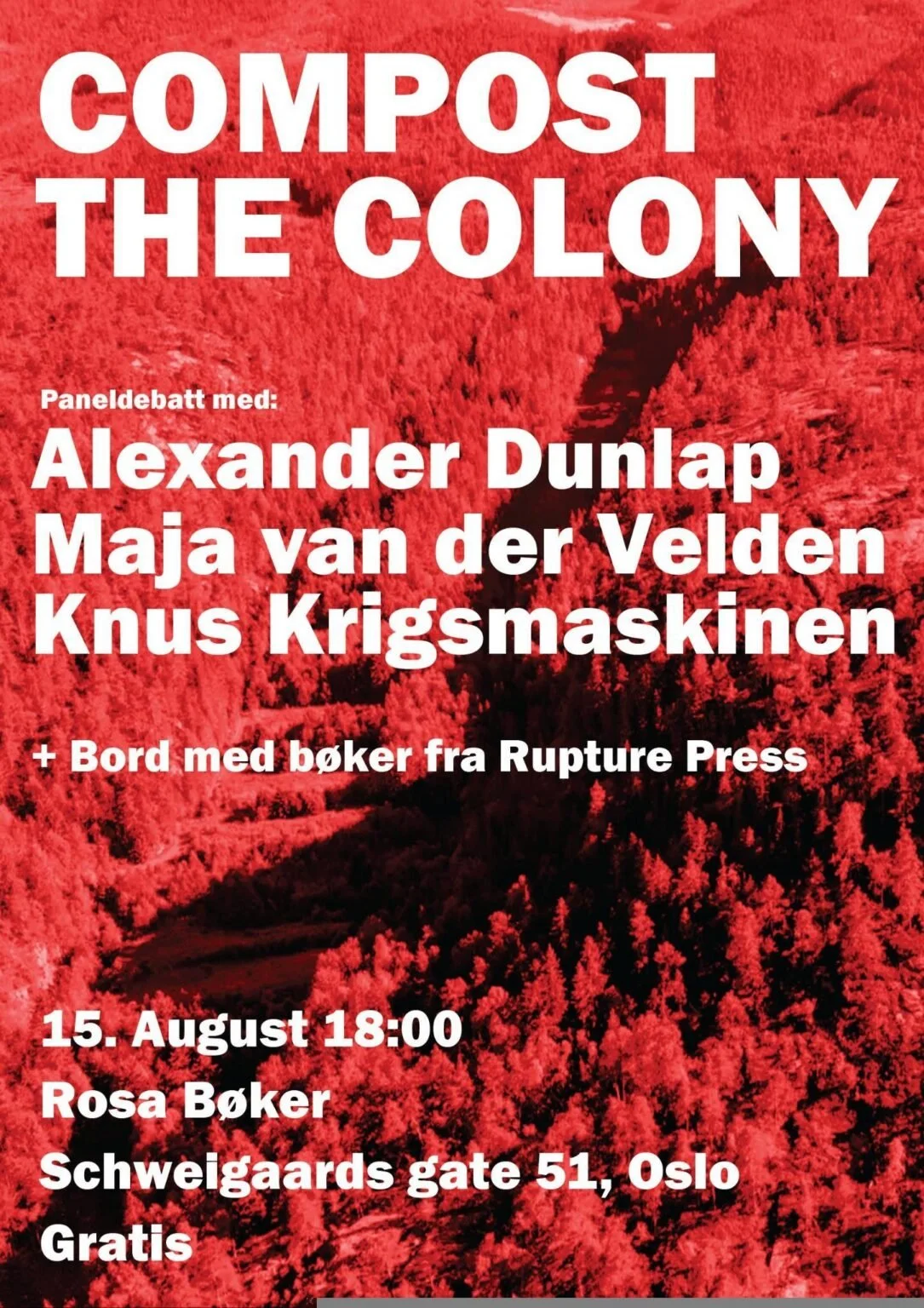
All the above hopefully suffices to explain why Smash the War Machine must also mean Smash Colonialism ("Knus Krigsmaskinen!" må bety "knus kolonialisme!"). As we look forward to deepening these conversations, we invite you to join our panel discussion "Compost the Colony" on August 15th, 2026, at 18:00 at Rosa Bøker in Oslo with Alexander Dunlap, Maja van der Velden, and a Sámi comrade.
Knus Krigsmaskinen!
ČSV!
Photo Credits: Kelly [Tusen Takk]. For more information: https://knuskrigsmaskinen.info/